

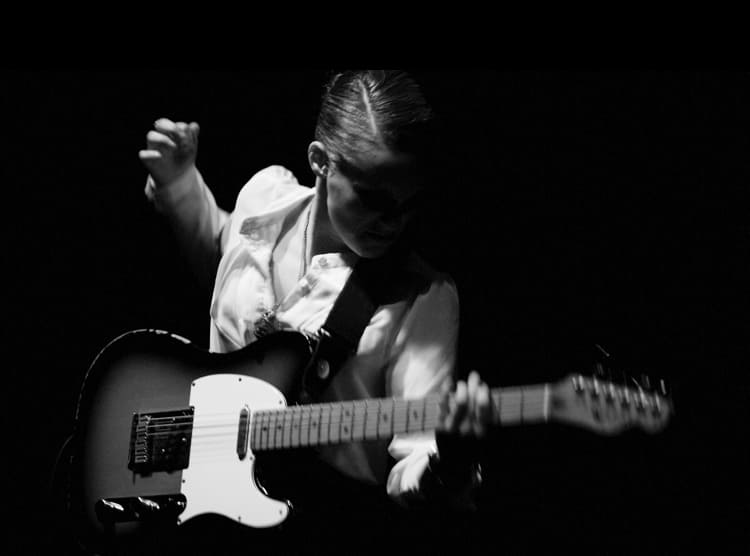
Anna Calvi on her new record, the tough first years of her life, finding her voice and how hypnotherapy helps her to be creative.
I find it interesting that it only took you six weeks to make your new album and it was less of a challenge than the last one. Do you think it’s perhaps because you feel more confident now?
I don’t think it was less of a challenge but I think having made one record already meant that I was more confident in the studio. I think it was easier to do in short amount of time because it meant I didn’t overthink things. And I worked more by my gut instinct which just makes the process easier and produces better results cause it can be quite a negative thing to go round and round and redo things and overthink. So in that way it was an easier process.
You wrote your first album in your parents’ attic. Where did you write this one?
In various places. I went to Paris for a while and I did it in my flat. It’s got bits and pieces in different places.
Did that make it less claustrophobic for you?
Yeah, I guess it was less claustrophobic. I think it was probably a healthier way of doing it.
How do you compose? Are you very methodical, sit down with your guitar every day and write or is it more random, whenever inspiration strikes?
When I was writing the record I was doing it every day but I think I’m not a very methodical person. Usually there’s a flash of an inspiration of an idea and that’s the easy part. And then the bit where you have to sculpt it and chip away at it, I find that the hard bit. That’s the bit that requires a lot of…it’s quite a frustrating period. I’m not too good at it but it’s necessary to finish something. You’re gonna go through that process.
Do the members of your band have any input in the songs?
I kind of flesh things out quite a lot on my own. I record ideas and arrangements but obviously they come in with their particular musical style and often a song will change once it’s in the studio and other people are playing it. And that’s a really good thing cause it can become more than it was, once it’s actually played by actual people.
It’s quite a small unit. Is it important for you that it stays that way?
Yeah, I think it’s good to work with people that you trust, that you’re used to and they know you and you know them musically and personally.
You’re very good at creating moods and conjuring up images. For instance, Sing To Me reminds me of a David Lynch film. Do you think of music in visual terms all the time?
Yeah, I’m very much a visual person. When I’m writing I imagine them like mini-films. Sometimes I sketch out an idea on paper, like drawings of what I imagine the scene to look like. So that side of things it’s like watching films or going to galleries, it’s important for me for inspiration.
Do you watch a lot of films?
Yeah, I do.
Which ones have left a mark on you?
I guess visually I really like Wong Kar Wai. I think the cinematography in his films is really amazing. I like David Lynch and I like Gus Van Sant’s films. Just films there’s a slightly surreal element to them and that are beautifully filmed. They’re usually my favourite.
I love the string arrangements on some of the songs. How important I classical music for you?
Yeah, it’s very important. For me the idea of creating a lot of tension and the releasing it…I love orchestral music and classical music and I use that technique as much as I can in my own music.
Have you ever felt torn between rock music and classical music, like wanting to go one way or the other?
I think they can coexist really well. And I think my favourite rock music is actually people that do that as well, like Scott Walker or Radiohead does it a lot. I think there’s definitely room for them to be able to be fluid.
The Bridge on the album is almost like church music. Are you a religious person at all?
I don’t ascribe to any particular religion but I do aspire to something higher or better. In that way I suppose I’m religious but it doesn’t fall under any particular institution.
Do you agree that it has a sort of religious feel?
Yeah. It’s meant to feel transcendentory and feel like it’s a moment of quiet before everything, before life starts again. And I wanted it to be meditative.
This brings me to the lyrics. Is it a very personal, autobiographical album?
Yeah, it’s a lot more I suppose personal than perhaps the first record. And part of that was just wanting to develop as a songwriter, and obviously what you wanna do is write the most truthful music that you can and so it’s a natural development to explore that. And also just the year that I wrote this record was quite turbulent and the things I was going through and what I was thinking about, they just naturally found their way into the songs and I didn’t try and stop them. I just let it happen.
You said it was turbulent. Can you talk a little bit about that?
Just stuff in my personal life. One thing that happened was a family member passed away and that kind of led me to think a lot about memories. There’s quite a few songs that deal with the idea of memory and you can’t really hold on to memories and that’s kind of sad but it’s also a really healing thing. Yeah, I was just faced with a lot of stuff that was actually kind of really helpful for the creative process I guess. It led me to interesting themes to explore.
You mentioned that some of it or all of it, I’m not sure, was inspired by your battle with depression. Is that correct?
No, that was a misquote from NME. I never said that. It’s not about depression. It’s about the moment before life changes. There’s always a moment like that where your life is going down one path and suddenly something happens and everything changes and it’s imagining that moment, almost like it’s just the breath before and just taking in all the sensations and how it feels to be on the edge, how thrilling it is. It’s scary but it’s also full of hope because whatever is gonna happen and however things are gonna change, the possibilities are limitless. You don’t know. So that’s what it’s about.
Does it mirror what you’re going through with your career at all?
No cause it wasn’t in any way about my music career. It was much more personal than that. It’s more emotional rather than…I wouldn’t find writing about my career very interesting.
What I meant is that your life must have changed quite dramatically in the last couple of years I suppose, no?
Yeah, I suppose on a practical level it has. I don’t feel like on a personal level, in terms of what my life is like, with my relationships with people or how I am as a person has changed.
So would you say at least part of this album is about grief?
Yeah, in a sense it is.
What meaning does the album title have for you? Is it related to that at all?
It’s basically what I said about it, being the breath before everything happens.
On stage people sometimes find you scary. Do you feel intimidating? Do you feel scary when you’re on stage?
I don’t feel scary. I feel like playing music and being on stage allows me to access a very brave, strong, part of me and perhaps that’s what people interpret as being scary but I don’t feel scary myself! It’s not really something that I associate with myself, being scary.
But do you enjoy projecting a strong, powerful image?
I enjoy getting in touch with that side of myself but it’s not an act, you know. It’s very important to me that I am expressing myself in an honest way and it’s not in any way like a stage…it’s not like a show. I don’t run around the stage and do stage antics. I pretty much stand where I am, in one place, and just express my music and sing in the post passionate, raw, honest way that I can.
You’ve often been compared to PJ Harvey. Artists never really like being compared to other artists but do you admire her and has she been an influence?
Yeah I do admire her. I think it’s great that she’s got a really solid career and some really interesting albums. She’s not someone that I…when I think about the artist that have really formed me and taught me a lot, she’s not one of them. But I can see that it’s an easy comparison because we’re women and we play guitar.
You’ve worked with one of her collaborators, Rob Ellis. What was that like?
It was great. He’s a dear friend of mine now and it was really wonderful to work with him. He’s very talented and very passionate about what he works on which is great. He’s interested in a lot of experimental, classical music which was exciting for me to work with someone that was interested in that kind of thing.
Brian Eno has been a bit of a mentor to you. How instrumental was he in you getting signed?
I was signed before I met him but he was the first person from the outside world that heard my record and was really positive about it and gave me a lot of confidence. So I feel really grateful to him and to have his support was just…it meant so much to me. I think it’s been a real help in my career definitely.
Was it daunting at all to be called ‘the best thing since Patti Smith’?
I just think it’s funny. It’s just him expressing his enthusiasm which I think is great. He’s just really enthusiastic about music and it’s really infectious and amazing to be around. There’s just no cynicism to him which is great.
How important have your music studies been for you to become the artist you are today?
I guess the main thing that it did was just introduce me to a lot of music that I probably wouldn’t know about so in that way it’s been really educational and I guess it’s given me a confidence in terms of arranging strings and things like that cause I had to study that sort of thing. But in terms of the songwriting it doesn’t affect how I write songs at all. But it’s kind of the stuff around, the periphery that it’s been of help.
Do you arrange the strings yourself?
Yeah, on this record I worked with someone. We kind of co-arranged together and that was really great because I didn’t have to spend hours writing everything out. Someone else did that for me so I could get the melodies down and the woman I work with, she’s called Fiona Brice. She’s really talented, really amazing musician, so that was very exciting to work with her.
Did you always know you were going to be a professional musician?
No, when I was a kid I wanted to be an artist. I used to draw all the time but I always loved doing music but I was planning on going to art college and at the last moment I changed my mind. I did music because I just felt like ‘that’s the thing I actually love more than anything’. And then I didn’t know how I was gonna make money out of music. I hadn’t really figured that out but I just got to a point where I was writing songs and I just thought ‘I should be singing my own songs. If I’m gonna write songs, I might as well sing them’. So then when I was in my early 20s I embarked on learning how to sing which was quite a big job. And I just practised for hours and hours and listened to singers I loved like Elvis and Edit Piaf, and I just gradually found that I had a strong voice which I didn’t realise I had before.
Your parents are therapists. Did you discuss with them this sort of block you had about singing?
It wasn’t quite like that because it just didn’t even occur to me to become a singer until my early 20s. And then I felt like I should try, I should see if I can do it. And then once I started…it was hard because becoming good at anything is hard. But it wasn’t like I had a block. I just worked really hard. I guess the block was that for most of my life up to that point the idea of singing was absolutely terrifying and I wouldn’t even attempt it. But there was just something in me that just felt like I wanted to see. Could I do this? The idea of expressing yourself through singing just seemed so amazing. I wanted to give it a try. But my parents have been really supportive. Obviously they’re therapists so they’re really good to talk to! My dad introduced me to a lot of music when I was a kid so I always felt like they’ve been there for me in that way.
The fact that you were terrified of singing, do you attribute it to one thing?
I think it’s just shyness, really. I have a soft speaking voice and the idea of being able to belt out really loud singing just didn’t seem like a possibility to me. But just with a lot of work and focusing…it’s the best thing I ever did.
What about the guitar, did it take a lot of work?
Guitar was pretty easy actually. I started playing when I was about eight I think. And I used to just play all the time. I had Jimi Hendrix and I was like ‘I wanna do that’. It was just really fun. It never felt like work.
Who were your heroes, apart from Jimi Hendrix?
Django Reinhardt, I used to really like. When I was a bit older I liked John McLaughlin. And then I just listened to a lot of music other than guitar music and tried to imagine my guitar was other instruments like it was a piano. And I really loved the way Miles Davis played, the idea that how you play each note and how it sounds is just as important as what notes you play. He plays in a very musical, expressive way and that was really inspiring.
I also understand your parents introduced you to hypnotherapy. What did you learn about it?
They used to hypnotize me when I was a kid. Like if I had a bad day at school, they’d had me lie down and make me imagine being somewhere else.
Did it work?
Yeah. I think it’s good as a kid to be hypnotised because it encourages your imagination to be really vivid because that’s what being hypnotized is. It’s getting lost in your imagination, where you’re finding the limitless potential of your unconscious. And so they always encouraged me and my sister to be imaginative and that’s definitely helped me. And then now having a creative career.
Have you tried hypnosis to make music?
Yeah, I did experiment with being hypnotized to see what that brought up in terms of thematic material for the record. It’s something I’d like to do more, maybe on the next record.
I also understand you spent the first years of your life in hospital. I don’t know if you have any memories of it but do you think that had a part in shaping who you are today?
Yeah, I’m sure it has. I don’t really remember much of it. I only remember one thing when I was three but I think…I actually think it’s encouraged me to be more imaginative because the way that kids deal with difficult things is they play and they make up their own world, a world which is kind of safe and that’s what being an artist is. You’re making your own world in a way that you can express all of these different things and work through all these things within the safety of a world which you’ve created which is different from the real world which you can’t control. And do I think it’s definitely encouraged me to do that more, having that frightening experience when I was a baby and a toddler.
Can I ask why you spent that time in hospital?
Yeah, I was born with both my hips dislocated so I didn’t have proper hip joints so I had to have lots of operations in order to create hip joints. So I had to be in a harness and they had to break my legs and put them back together. You know, doesn’t sound like much fun. I’m kind of glad I don’t remember.
You have an Italian heritage. So where does your passion for flamenco come from?
I guess I really love the way that they dance. And I love the outfits. I love how passionate it is. It’s really romantic but it’s also very violent in a way and that’s just my kind of thing. This is what I’m into. And when for the first record I was trying to think how to express the music visually, I just felt like it was a good reference point because it has all those elements of being fiery and passionate, romantic and so I had outfits inspired by my own flamenco dancer.
On the new album, I love Eliza. What is that song, and the video about?
It’s about the idea of seeing someone else and them being really beautiful and serene and perfect and seeing something in them that makes you realise that you lost a part of yourself and you want to I suppose commune with them in a way to try and reconnect with that part of yourself. So I guess the video is in a way a visual representation of that idea.
Piece by Piece is very unusual. Can you talk about that track?
Yeah, that song is basically about memory. It’s me reminiscing about this particular memory that I had and how the more I think about it, I’ll never be able to hold on to that memory and every time you think of a memory it’s a copy of a memory. The idea that no matter what you do these memories are disintegrating and changing, that’s really sad but it’s also really healing because you can always move on in your life and so the whole song is about that memory and how it fades. And it’s made up of all the pieces of the memory, musical pieces that then disintegrate. It is interesting for me now singing it because what the song says is gonna happen is now happening. When I sing that song, when I think about that memory it’s faded more than it was when I first wrote the song. And so it’s quite interesting the way it’s kind of predicted what’s happened, you know?
I guess that song is one of the songs you were talking about earlier on, about grief, perhaps?
It’s partly to do with that and partly to do with I guess a relationship that I had. But yeah, it was something that I was going through and thinking about and I just felt it was important to express it in a song rather than hold off.
One of my absolute favourites is Carry Me Over. Can you say a few words about that song?
That was a song where the idea of like…the middle section I wanted to be really hypnotic and to really take the listener on a journey into a different world. And the song is kind of about the mechanics of the body, the way you exist in this outward life but there’s another whole world inside you with all these cogs turning and that’s all you really have is the feeling that your heart is just gonna go on and on. No matter what happens out there, there’s this thing that’s relentlessly pushing you forward and that’s kind of what the song is about and that middle section is about.
You seem to put a lot of thought into your lyrics. Is it down to your parents, this very analytical streak?
I guess having therapists parents, you do a lot of analysis when you grow up, you know? But the thing that I find is I’m very emotional but I really can’t in any way control my emotions. I can’t…I’m not methodical and organised. I feel things very intensely which is hard in my everyday life but in music it’s really good. It allows me to be really expressive. So I wouldn’t really say that I’m analytical when it comes to music. It’s more like I want it to be raw and emotional and I guess I just try and find the most visual atmospheric way to express these stories.
Your breakthrough has happened relatively late. Did you at all doubt it would happen and did you have back-up plan?
I didn’t really have a back-up plan so it’s kind of lucky that it turned out alright. But I think it’s actually really good for me that it happened a bit later cause I don’t think I could have dealt with it when I was a teenager. I also feel that I had more life experience. I have more to talk about than I did when I was in my early 20s. If you look at other art forms and filmmakers, it’s kind of understood that one’s first film isn’t gonna be the best. You grow into being the artist that you are. And I think the same is for music, to experience life experience and experience of being a musician and a songwriter you grow. I think it’s changing a bit but I definitely think the idea of what a 17-year-old’s got to say is… I’d rather listen to an 80-year-old talk about her life personally. Not that… obviously the benefit of being a teenager is you feel everything so intensely and that comes out in people’s music when they’re young. But I don’t think you necessarily loose that. I haven’t lost it personally.
I agree with you but I think it’s rare nowadays to see artists who take the time to grow before breaking through.
I think actually it’s maybe more common than it used to be but…I think it’s just the bigger cultural problem with the obsession of youth, which ultimately is people’s fear of their own mortality. Let’s fake it and pretend it’s not gonna happen. But I suppose the kind of music I listen to it’s really not relevant how old someone is. It’s just whether they’re good.
What’s the music that you’re listening to?
I listen to a really wide range of music. I really like Wild Beasts, on Domino as well. I’ve been really enjoying Nick Cave’s new record. I like Patrick Wolf. I listen to a lot of classical music. I listened to a lot of minimalist music when I was making this record, like Steve Reich. I listened to Tom Waits, Edith Piaf. It’s a wide range.
Before making the record, did you have a clear idea of where you wanted to go with it?
Yeah, I wanted it to have a wide spectrum of emotion and colour. I thought a lot about the texture of it before I made it, that I wanted the guitar to come in at the really emotional climax of the song for it to have a raw wildness about it, which is why I listened to Tom Waits cause I really like the way he suggests the chords, using really unusual instrumentation, rather than just a guitar strumming, it’s really amazing colours and textures. So that’s kind of what I was thinking about before I started writing. Then when I started writing the songs it was more just instinct of whatever came out and I just went with it.
It also has very strong melodies. Does it come to you naturally, these catchy melodies?
I wanted it to be melodic record. So I did think about that and try and develop that side of it as much as I could.
Do you enjoy a good sing-along?
I’m kind of weird. My relationship with singing is I don’t really sing along to stuff. I have never done karaoke. That sounds terrifying to me!
Are you comfortable with the fame aspect that comes with your job?
I’m just not famous enough for it to be an issue but I think if I was I would find really difficult. I think I’m at a good level where I get to do this as a career but I don’t have to deal with the side of people recognizing me on the street and things like that.