

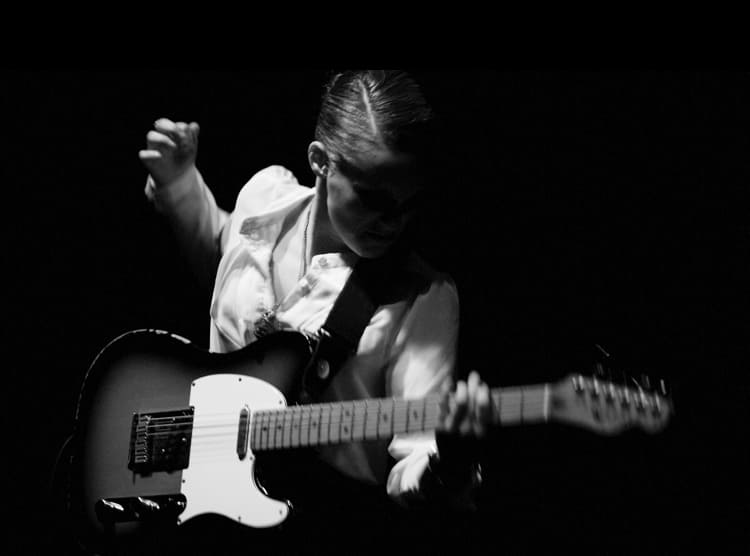
by Marco Bianciardi
With her unique vision of sound and musical personality, Anna Calvi embarks to a world unseen. Two years after her multi-nominated debut album of 2011, the English musician is back with One Breath: ten new songs soon to be presented on tour, and officially released on the 7th of October. Marco Bianciardi, singer of the Berlin band The Somnambulist, has reached her for iCrates at the office of Domino Records in town.
Somehow you grew up surrounded by vinyls, your father’s collection was your first contact with music, so I suppose vinyl could probably mean something particular for you.
I think it’s nice with vinyl the way you get the artwork really big, because it kind of feels like a piece of art in itself. And it’s definetely more fun putting it on, than putting a CD on. I have quite a lot of vinyls in my flat, some of it’s stuff I’ve stolen from my dad, some is stuff I’ve bought since.
And I suppose your second album, One Breath, will be also released on vinyl. Are we going to see some special artwork dedicated to the vinyl edition?
It is sure.
Can you say something about that?
I want it to be a surprise.
Because it’s related somehow to vinyl, what’s your opinion about the mp3 and the way it has changed the music market in the last ten years?
I think the Internet has caused people to not really have much patience, and that goes over every type of area in life, one of them being music, which is a shame. I don’t think it is benefiting music, to not have the patience to listen to a whole album or a whole song, or listen to something that isn’t a really squeezed, compressed file ‘cos you can get it [snaps] like that. It’s a shame.
Something I’m interested in is Anna Calvi before Anna Calvi, your self-titled debut album of 2011. There’s not so much information about you, especially about a band called Cheap Hotel that you were in.
It was just a band I was in with some friends. We lasted about a year then we broke up. It’s something particularly interesting… , isn’t it?
Was it hard to emerge from the London music scene? I personally don’t know it directly yet, but all the “legends” coming to Berlin from there tell of how hard it is to get started with your own music and get some attention for it, because of competition between lots of bands, bad conditions for gigging and so on. How was your experience, as a beginner?
I think it’s difficult because there is not much respect for musicians, and there are so many bands put on on one night, like six bands or so, and it’s just getting your friends, you know? You have a sense that no one really gives a shit. That is hard and then obviously when you get slightly more, if you get a little bit of press and you have a single out or so, then things start being better. But the bottom line is that before you are signed, before anyone knows who you are, it’s not fun to be playing gigs in that environment.
How did you get to Domino Records? Nowadays, almost all the labels try to defend themselves from a bigger waterfall of new musicians working hard for their own piece of a smaller pie, so most of them don’t accept unsolicited demos anymore.
The ex-guitarist of The Coral, Bill Ryder-Jones, he saw me playing in Manchester and told Domino about me, that’s how I got signed.
If, by accident, you didn’t get a record deal, what would you do?
I mean, I probably would have put the first record out myself, but if I wasn’t gonna do music, well, I don’t really know, do you?
I’ve read somewhere that, at an early age, you were attracted to “the impressionistic element” of certain music of the last century like Debussy and Messiaen. Can you tell me more about?
I think it’s to do with the music telling a story as much as the lyrics. Like Debussy, said with a piece like “La mer”, it sounds like the sea, it’s not just the title is the sea. He really tried to make the music always become the sea, and that’s kind of what really interests me, the idea of image and music being overlayed, like you don’t know where one stops and one begins. And the music really kind of conjures a story itself, even if the lyrics won’t do that.
I personally find something quite new and original in your music. It’s something for me that is hard to describe at the moment because I’m sure it will become much more evident with your next couple of albums. And that’s really interesting, because right now we haven’t got so many new bands who are proposing original music, in a way that could make them be representative of our current times. Most of them take some ready-made music genre from the past, and just update it on the current standards of sound. Well, what’s original in you is not only a huge spectrum of different music from the past which is present in your work at the same time, but also the way that the past, more than just being a reference or a quotation, resounds in your songs like echoes in an empty chamber, like if the old music has been recalled out of a dream. The question is: is this something you are conscious of, or I misunderstood?
I think it’s not conscious, but I do listen to a lot of different kinds of music, so it probably unconsciously comes out. I am definitely interested in the idea of the classic song, that’s kind of an inspiration for me: the classic song being something like an Edith Piaf’s song or Roy Orbison. That’s more interesting to me than what some band did last year, you know, who played a festival and they got these really cool songs. That kind of nebula just doesn’t hold that much interest to me, so perhaps that’s what you’re picking up.
I just got your new record, by the way I’ve been totally amazed to hear that the main two new entries in your sound are poles apart: distortion and orchestra. Referring to my last question, about the future that’s not there yet as being squashed by a past which is always present, and the mood fin de siècle of your music, it was really satisfying to see the ghost of Gustav Mahler inside the orchestral coda of the title track. Did you write and arrange the strings on your own?
Yeah, I’ve arranged them with another arranger I’m collaborating with. It’s an interest that I have and I’m ready to explore further, this side of my interest in classical music and orchestration.
I could say that with you we have finally got somebody who’s really applying the discipline of classical music to popular songwriting, not just in terms of giving a blurry baroque colour to rock’n’roll. So that’s why I think we find in your songs that “game” of stretching the time of music. I mean, in your songs there’s always something which is shorter or longer than expected.
I do definitely think a lot about stretching time, I don’t know why. I get really obsessed with the idea that, you know, like art, understanding of time is completely dependent on… you know, time is not real. And that’s really kind of fascinating to me, the idea that music can manipulate time, your sense of time. And so there’s definitely stuff on the album that’s trying to do that. Like One breath [the title track of the album], it’s a song about the time it takes to inhale and exhale, and how, when you’re about to do something that you’re really scared of, or is gonna really change your life, for the better or for the worst, time slows down. Like as if you’re in an accident, time is slowed down. It’s that idea of going microscopically into the situation, and kind of drawing as much from it and as much detailed as you possibly can.
The moment you use some music language of the past, you necessarily have to deal with the memories of the listener. You know, history is getting old. So, at the moment you stretch the time of music in a way which is not expected by historical memory, but at the same time which is perfectly coherent with that particular song you’re writing, then you can make your songs flow like a river. And this is something that personally I’ve found just touched on the late Jeff Buckley. So I was wondering, because he’s not there anymore, if sometimes you feel like you’re taking over his job.
[Laughs] When I was first kind of becoming a proper musician, like understanding what it was I liked to do, and I was a late teenager, Jeff Buckley was definitely my sort of hero, and I’ve listened to him a lot. I don’t listen to him anymore because I don’t need to, I know every single note of the first record and stuff.
Another artist you look like you’re taking over the job for, is Bowie. Not because he’s dead too, of course, but ‘cos somehow it looks like he gave up a certain experimental side in his songwriting. Do you also feel you’re taking the path he didn’t have the courage to follow until the end?
I do feel like to try to find a path that is both experimental and popular is obviously, I imagine, the artist’s dream. You could go on an experimental journey with your music whilst people still liking it. To get that balance is really tricky but I think that’s the answer to being creatively satisfied, so it is always something you try and aspire to.
I was really surprised to read that you were introduced by your father to hypnosis, ‘cos hypnosis was one of the first things that came to my mind when I listened to you for the first time. It made me wonder if maybe you learned from him some techniques you could have applied during your songwriting, or if it’s just a generic suggestion.
Hypnosis is about being in an altered state, which we are in constantly throughout our lives or our days. It’s a lot about self-hypnosis. It’s the power of suggestion which stays in your brain, takes over and hypnotizes you. I am constantly self-hypnotizing myself, always in dreams and away somewhere else, and I think that definitely kind of comes out in my music.
Just a few years ago you still had a psychological block about singing. It’s interesting how this block resolved in what I could call a theatrical voice.
How do you define theatrical?
You know, you’ve got several voices, not just because your speaking voice is different from your singing voice, but also because you use more than one voice in your songs. And the work is going on: in Piece by Piece [3rd track of the album] maybe for the first time you’re singing in falsetto. It’s like several characters acting in your songs like in a movie, and they’re taking place more and more inside your voice. It looks like you’re trying to exceed the single personality.
I do definitely try to stretch my voice, so for this record I wanted to try and experiment with it. You know? You could still be really intense by singing softly, so that in one song there could be a really wide range of dynamics, going from the whispered to really belting out, as opposed to a song just having one level of dynamics all the way-through. I didn’t like the word “theatrical” just because I think it suggests things being put on, like not being real. But I definitely feel that, whatever voice I use, it’s a part of me that feels honest, and I wouldn’t want to do it in another way. But I’m definitely drawn to singers that can really manipulate their voice depending on what song, rather than having one favorite they can do. I mean, David Bowie’s great at that, there are so many different voices over the albums, it’s pretty incredible.
Exactly, that’s what I meant: not a fake melodramatic attitude in singing, but hosting a theatre in the mouth. It’s about acting vocally as a state of trance during the performance, not as pretending. Something extremely honest. But let’s move on. We can stretch the time in music, but unfortunately not at all in an interview. Did it take more time to make the first album or this new one?
The first.
Was this because you had less time between the two records, compared to before your debut? You had to tour a lot after it, for example.
Because the first record was recorded before I was signed, I didn’t have anyone saying “ok, this has to be done by…” so it stretched over years. Whereas this one I spent a year until I recorded it.
Do you like this fast way of creating, or do you miss the time when you had no pressure at all?
I think it’s dangerous to be given as much time as you want, because you end up just kind of chasing your tail, re-doing things and getting really hung up on stuff that is not really that important. Whereas when there is a time limit, it kind of makes you see clearer, because you do not have time to get really distracted and go off on some tangent that eventually you’ll just come back to and redo it anyway.
In this new record we find again Mally [Harpaz, percussions/harmonium/guitar] and Daniel [Maiden-Wood, drums]. We’ll see them again on stage too?
I also have a keyboard player now.
I was wondering about the orchestral parts in the studio album, how they’re going to be rendered on stage, ‘cos I can’t really imagine something like “Anna Calvi & Orchestra”…
I think it’s important when you play live to re-imagine songs so as they don’t have to be exactly the same. The orchestral elements will find their way into live shows in some kind of capacity, whether it is playing with the guitar or not. I wouldn’t like to get a keyboard to play fake strings or so.